Many Drives,one pool
Tributary is an open-source, self-hosted file manager that joins your Google Drive accounts into one pool of storage.
Many into one
A tributary is a small river that joins a larger one, the way the Yamuna and the Kosi join the Ganga. Each Google account gives you 15 GB free, so three accounts hold 45 GB. Tributary shows them as one place to put things.
Link your accounts
Sign in to each Drive once. Tributary asks Google only for files it creates or that you pick, never your whole Drive.
See one pool
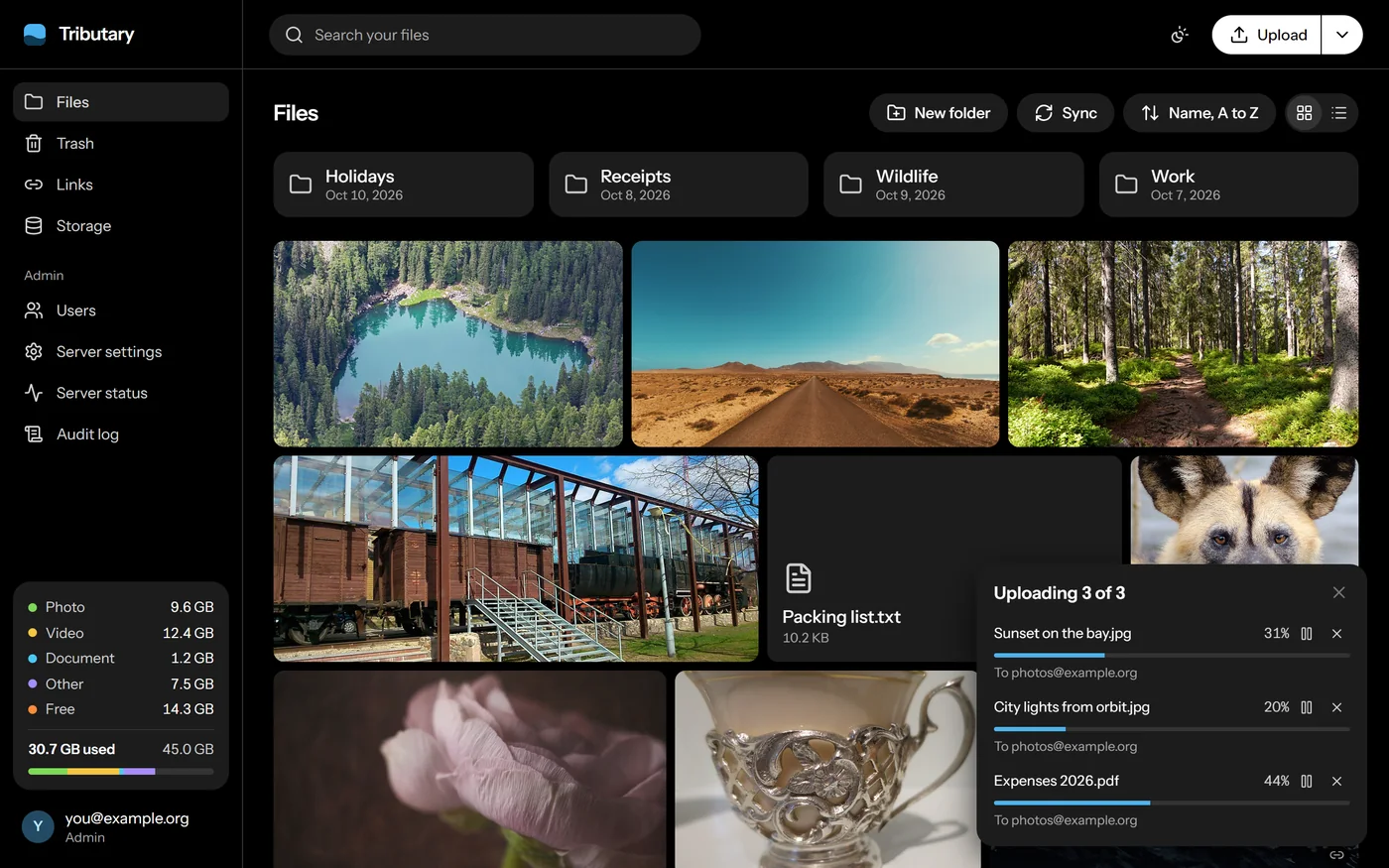
Free space adds up across accounts, and everything sits in one set of folders, whichever account holds it.
Keep your files
Each file sits whole in one of your own accounts, so the largest upload is what one account can hold. Stop using Tributary and they're all still in Drive.
Choose where files go
Each person picks how their uploads are shared out. You can always send a file to one account yourself, and an account that's full or can't be reached is skipped.
Each file goes to the account with the most free space, so your accounts level out.
- 5.8 GBfree of 15 GBnorth.fork
- 10.4 GBfree of 15 GBsouth.fork
- 13.6 GBfree of 15 GBlittle.creekNext file goes here
- Press upload and watch where the file goes, then try another mode.
What it does
Upload anything
Send files or whole folders in pieces, so an upload can pause, resume and survive a lost connection.
Where everything lives
| What | Kept in | Who can reach it | If you stop using Tributary |
|---|---|---|---|
| Your files | Your Google Drive | You | They stay in Drive |
| Folders | Drive and your database | You | They stay in Drive |
| The trash | Your database | You | The list goes, the files stay |
| Google tokens | Your database, encrypted | Your server | Revoke them at Google |
| API keys | Your database, hashed | Whoever holds the key | They stop working |
| Public links | Anyone with the link | They keep working |
About
Tributary used to be called dextro, which is why the folder in your Drive still has that name. It's a Go server, a small Node web server and PostgreSQL, and it runs on your own machine with Docker. One admin runs each server and creates accounts for other people, and each person links their own Drives and sees only their own files. There are no analytics, and the only outside service it talks to is Google, on your behalf. It uses a narrow Drive permission, so it sees what it created and what you pick, and nothing else. The code is on GitHub under the MIT licence, so you can read it, run it and change it. Your storage, joined up, on your own terms.